Retail payments: Why local payment methods drive global conversion

- The true cost of payment friction for retailers
- The value-driven consumer and the checkout experience
- Bridging the conversion gap: Solving high-stakes pain points
- The retail payments landscape: Regional snapshot
- Why retailers partner with PPRO
- Looking ahead: The 2026 mandate for global retail
The global e-commerce market reached $8.3 trillion (USD) in total transaction value in 2025, representing a 55% increase since 2021, and this growth shows no signs of slowing. By 2030, the market is projected to exceed $10 trillion, presenting a significant opportunity for retailers worldwide.
Unlocking this growth, however, requires a clear, market-specific payments strategy. With the right payment mix in place, retailers can transform the checkout experience into a strategic growth lever that directly influences conversion rates, customer loyalty, and international expansion.
Recent research underscores the importance of an optimised payments experience: 72% of merchants report higher rates of failed payments for cross-border transactions compared to domestic ones, creating friction that drives customers away. At the same time, 94% of cross-border shoppers expect to pay in their local currency, while 99% want to use their preferred, customary payment methods.
As a result, familiar local payment methods have become a key differentiator between retailers that successfully capture global demand and those that lose customers to checkout abandonment.
The true cost of payment friction for retailers
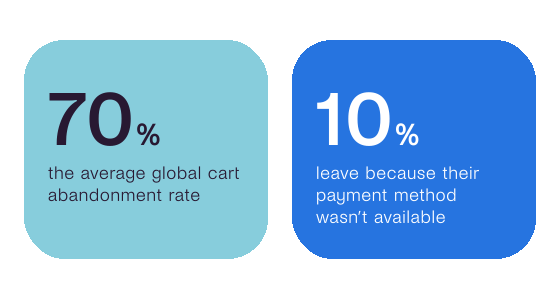
Cart abandonment remains one of retail’s most persistent challenges. Globally, the average cart abandonment rate is around 70%, rising to more than 75% on mobile devices. Consumer research indicates that payment friction is a key reason for lost sales: 19% of shoppers have abandoned a checkout because they didn’t trust a site with their credit card information, 18% because of an overly complex checkout process, and 10% due to a lack of available payment methods.
Data consistently shows that shoppers abandon their purchase because their preferred payment method isn’t available. When shoppers encounter an unfamiliar checkout experience – especially when buying from an overseas merchant for the first time – the likelihood of abandonment increases sharply.
The knock-on effect on a business’s finances is significant. Online retailers collectively lose an estimated $18 billion annually due to abandoned carts, with the projected value of merchandise left sitting in online carts reaching around $4 trillion each year.
The value-driven consumer and the checkout experience
Retail is experiencing a fundamental shift in consumer behaviour. While price remains a significant factor in purchase decisions, as much as 40% of a consumer’s perception of value stems from non-price factors. These include how easy it is to pay, the availability of trusted payment options, and how frictionless the overall checkout process feels.
For global retailers, this means a localised checkout experience is essential. Consumers rely on familiar payment methods to establish trust when shopping with a merchant for the first time. The data supports this: businesses that offer local payment methods experience, on average, a 12% increase in revenue and a 7.4% boost in conversion rates.
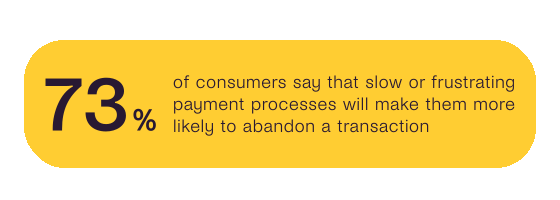
Speed and payment security matter too. 73% of consumers say that slow or frustrating payment processes will make them more likely to abandon a transaction, while 64% consider security the most important factor when making a purchase. Overall, 56% of shoppers say that poor payment processes make them less likely to remain loyal to a brand, highlighting the lasting impact of a bad checkout experience
Bridging the conversion gap: Solving high-stakes pain points
Retailers expanding globally face several operational challenges that directly impact revenue.
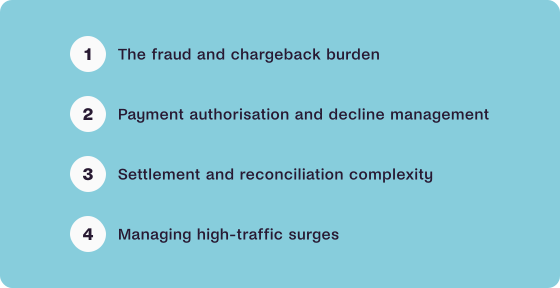
The fraud and chargeback burden
Fraud and chargebacks represent a growing financial and operational drain for retailers.
Forecasts indicate the total cost of e-commerce fraud will rise from $44.3 billion in 2024 to $107 billion in 2029, a 141% increase. Across Europe, detected digital payment fraud per 100,000 transactions has more than doubled since 2022, driven by sophisticated tactics like account takeovers, bot-driven card testing, and AI-enabled scams.
Chargeback rates are also growing. Sift’s Digital Trust Index shows that retail e-commerce chargeback rates surged by 233% between the first and third quarter of 2025. Correspondingly, the cost burden on merchants has also increased, with worldwide chargeback losses expected to climb from $33.79 billion in 2025 to $41.69 billion in 2028.
Many local payment schemes are working hard to significantly lower fraud rates. Brazil’s Pix combats fraud with a multi-layered security framework that includes mandatory user authentication, traceable transactions on a private encrypted network, a shared anti-fraud database to flag suspicious users, and protective measures such as transaction limits and “precautionary blocks” on suspected fraudulent transfers. Meanwhile, European payment methods like Wero and BLIK are increasingly incorporating advanced security features, such as biometric verification, to ensure transactions are properly authorised.
In addition, by diversifying into local payments that don’t support traditional chargeback flows, merchants can protect their revenue while reducing the operational overhead of dispute resolution. Unlike card payments, many local payment methods are “push” payments, meaning funds are sent by the consumer and, once authenticated, are difficult to reverse. This significantly lowers the risk of “friendly fraud” and the need for manual investigations.
Adopting local options and their secure fund flows helps merchants avoid the higher fees associated with card chargebacks, while enabling more predictable settlements and streamlined financial reporting.
Payment authorisation and decline management
Failed payments account for up to 11% of lost e-commerce sales, but few merchants have a clear understanding of the underlying causes. By taking steps to identify and resolve the root causes of failed payments, retailers can improve authorisation rates and maximise sales.
In Latin America, cross-border card success rates are disproportionately low because most cards only work for domestic transactions. For this reason, global retailers often work with a payments partner as their Merchant of Record (MoR), which processes transactions locally before transferring the funds to the merchant’s bank account.
Beyond basic processing, advanced features like smart routing, automated retries, and account updater – a tool that provides real-time access to updated details for expired or lost cards – stem involuntary churn and significantly lift approval rates. For a truly optimised checkout, offering locally preferred digital wallets, cards, and bank transfer options can increase first-time payment success, as they are built to work seamlessly within local banking ecosystems.
Settlement and reconciliation complexity
A global multi-market retail strategy often leaves finance teams drowning in operational complexity. The core challenge arises from fragmented payment systems: each local market and payment method typically generates its own unique settlement file, reporting format, and currency requirement. For retailers, this means that every market launch adds to their operational burden, as finance teams manually reconcile disjointed data across various jurisdictions.
To solve the challenge, leading retailers use platforms like PPRO that unify reporting and settlement through a single, global API. This means that instead of managing dozens of data sources, merchants receive a consolidated view of performance. This leads to:
- Simplified operations: Merchants can access unified reporting and settlement files across different markets and currencies.
- Faster cash flow: Streamlined fund flows ensure sellers get quicker access to sales proceeds – essential for paying suppliers and managing working capital.
- Reduced manual overhead: Automated tools like transaction matching reduce errors and save time, allowing staff to focus on initiatives that drive business growth.
This orchestration layer also accelerates the onboarding of new local payment methods, significantly reducing time-to-market while driving performance at a local level.
Managing high-traffic surges
International retailers are under pressure to handle unpredictable spikes in activity, particularly during major campaigns or shopping events like Black Friday, when transaction volumes can jump by as much as 62% compared to a normal trading day. But to convert traffic into sales, retailers need a checkout that doesn’t slow down when payment volumes peak. Research shows that today’s tech-savvy shoppers are impatient; a wait of more than three seconds for a checkout page to load will cause most consumers to look elsewhere.
A reliable payments platform is therefore paramount; scalable infrastructure prevents the downtime and slow response times that lead to cart abandonment and erode customer loyalty.
The retail payments landscape: Regional snapshot
To tap into the next wave of opportunity, retailers must tailor their payment mix to the specific nuances of high-growth regions. Payment preferences often vary from country to country, reflecting cultural habits, access to modern technologies, and local payments infrastructure.
Europe
Europe is a diverse market, with card payments, digital wallets, account-to-account (A2A) payments, and Buy Now, Pay Later (BNPL) widely used across the region. Although card usage remains prevalent, accounting for 39% of e-commerce transactions, digital wallets, A2A, and BNPL are growing rapidly.
By 2030, digital wallets are projected to take the lead, accounting for 46% of all e-commerce transactions, while A2A is expected to secure a 21% market share. Meanwhile, BNPL is forecast to grow at a compound annual growth rate (CAGR) of 15.4% between 2026 and 2031. For retailers in sectors such as electronics, home goods, and apparel, offering locally preferred BNPL options helps increase average order values and meet consumer expectations for payment flexibility.
Across these payment types, various local payment schemes dominate in specific countries. In the Netherlands, 70% of online payments are made with iDEAL, a bank-to-bank payment system. In Poland, BLIK is key: 64% of Poles use the payment method to pay for goods and services online.



Latin America
Latin America is experiencing explosive e-commerce growth, yet it remains a region with a large underbanked population where cash-based solutions remain vital.
Brazil’s instant payment system, Pix, has revolutionised the market. By 2027, an estimated 51% of Brazilian e-commerce transactions will be made through Pix, overtaking credit cards. Launched by the Central Bank of Brazil in 2020, Pix now has 176 million users and is on course to surpass 7 billion monthly transactions.
The model is spreading. Colombia’s Bre-B – often referred to as “the Colombian Pix” – launched in 2025. Meanwhile, Peru is reported to be implementing a real-time digital payments system based on India’s UPI infrastructure. Across the region, Mexico, Peru, Argentina, and Colombia are all expected to rank among the world’s top 10 growth markets for real-time payments in the run-up to 2028.
Despite the shift towards digital payments, cash-based payment methods (also known as eCash) are widely used in certain countries. In Mexico, where around 51% of the population is unbanked, Oxxo Pay enables consumers to purchase an item online and pay in cash at an Oxxo convenience store. While the use of cash is slowly declining, failing to offer cash-based options prevents brands from reaching a large portion of Mexican consumers.
Lastly, card payments continue to play an important role in e-commerce, accounting for more than half of payments in Latin America. However, domestic card brands like Elo or Naranja often aren’t enabled for overseas use, even if co-branded with Visa or Mastercard. This results in high decline rates for retailers relying on offshore acquiring. To overcome this obstacle, leading merchants implement local acquiring, often enlisting a payment partner to act as their MoR.



Why retailers partner with PPRO
To win in global e-commerce, you need to offer the payment experiences locals expect, wherever you are. We help you navigate the complexities of international expansion, turning local payment insights into your competitive advantage.
Scale faster, globally
PPRO lets you build once and scale continuously. Our single connection gives retailers instant access to over 85 markets, allowing you to launch in new regions while your competitors are still stuck in the integration phase.
Checkout like a local
Consumers want to pay in a way that feels familiar, secure, and convenient. From Pix in Brazil to BLIK in Poland, we give you access to all the local payment methods that matter. If you’re not sure about the right payment mix for a market, our experts will guide you to the payment options customers know and love.
Performance you can rely on
When the stakes are high, PPRO’s platform delivers. Built for the peaks, we successfully processed around €1 billion in volume during the Black Friday and Cyber Monday sales in 2025. Plus, conversion-boosting features like smart routing and automated retries enhance your authorisation rates and maximise sales.
Remove the operational burden
PPRO handles local complexities so you don’t have to. From calculating and deducting local taxes in regions like LATAM to streamlining reporting and settlement across countries and currencies, we simplify your back office. Get one settlement file, one reporting format, and more time to focus on your core business.
Looking ahead: The 2026 mandate for global retail
As we look toward 2026, the mandate for retail leaders is clear: focus on what is within your control by doubling down on payment fundamentals. While the macro environment remains uncertain, you can drive global conversion by elevating your checkout experience with the right payment mix and data-driven insights.
Digital wallets are projected to account for 65% of global e-commerce payments by 2030, with alternative payments more broadly expected to account for 79% of online transactions. Retailers that fail to adapt risk losing sales and customer loyalty, as shoppers look elsewhere for the payment options they prefer.
The path to higher conversion and stronger retention lies in meeting consumers where they are. By localising the customer journey, you transform a transactional process into a strategic route to deeper customer engagement, higher conversion rates, and faster growth.